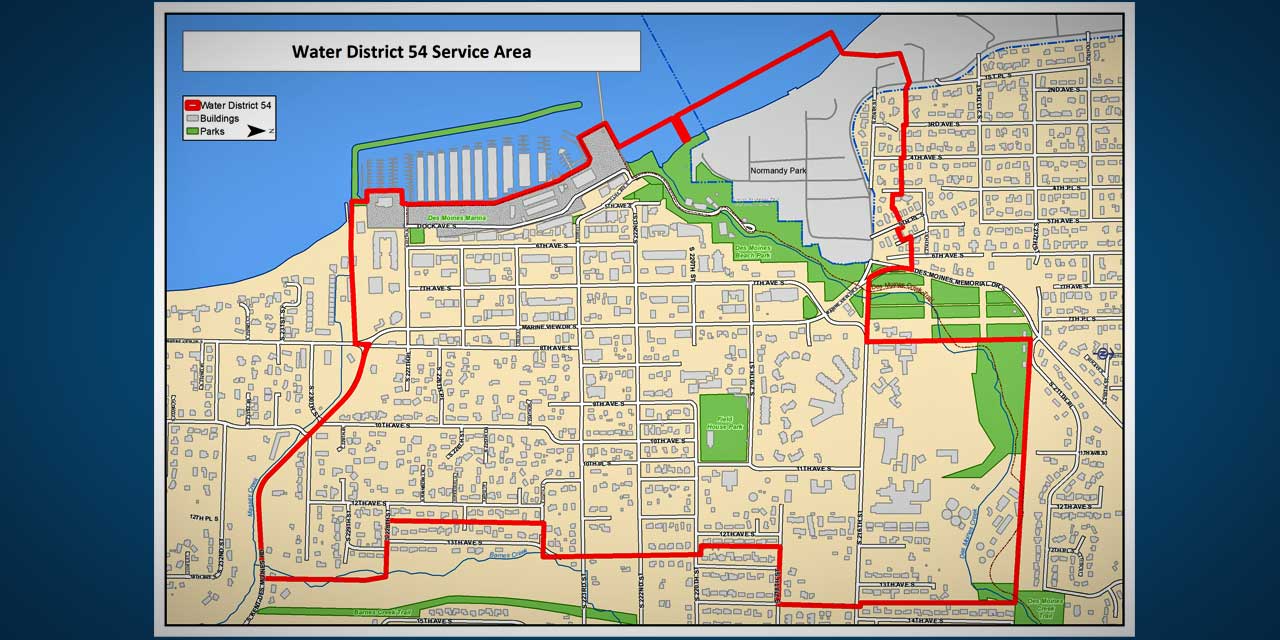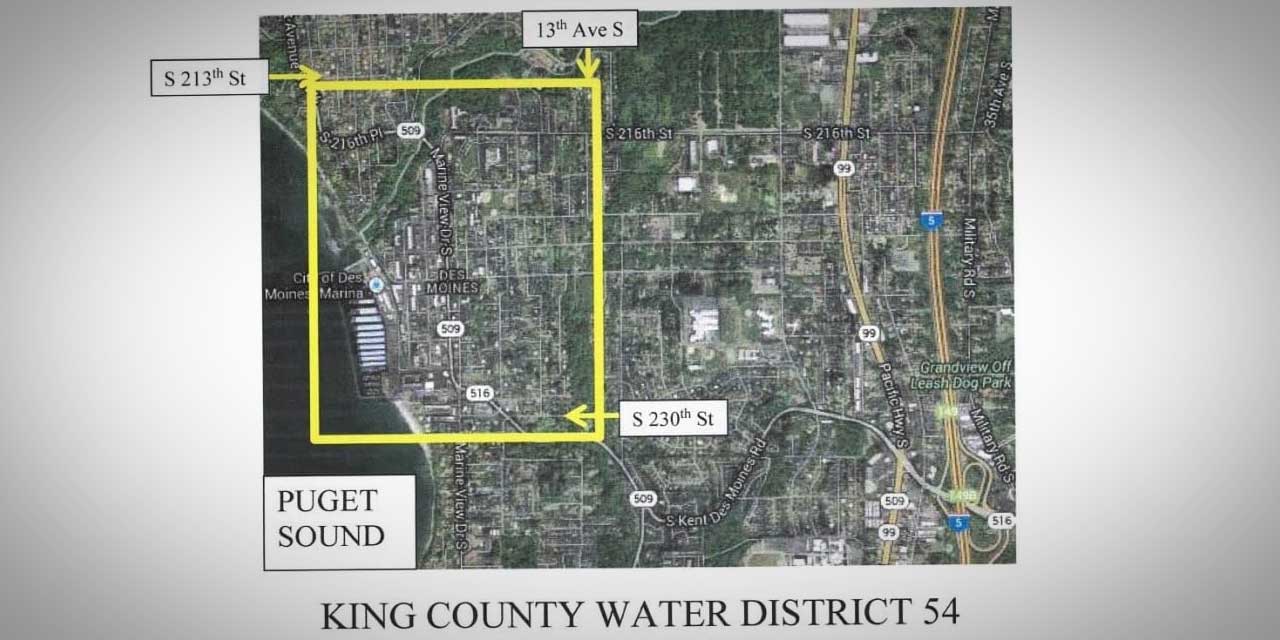
A long-simmering disagreement between the city and Water District 54 over upgrades to the water system in downtown Des Moines was expected to boil over at the June 3 council meeting.
There was even a possibility that the city would begin the process of assumption – the takeover of the water district – if council members didn’t get the answers they wanted.
Instead, the meeting began with Water District 54 Commissioner John Rayback informing them that “the commissioners think the district can now put a line down Marine View Drive.”
Following their May 20 council meeting, several lawmakers expressed frustration over what they considered to be a pull-back by the commission from what they thought had been a preliminary agreement reached at a joint meeting in April for installation of a new 12-inch water main along Marine View Drive.
To do this, Rayback said, the water district “will need the city’s assistance and will need concessions from the city.”
City assistance would include a $486,000 federal earmark secured by Rep. Adam Smith, D-Tacoma, which is dedicated to water system improvements in Des Moines, Rayback told council members.
“And the city needs to waive all permit fees” associated with the project “if you’re really serious,” he said.
This project “will still be very expensive … we need to keep costs down.” But, Rayback added, “We think it can be done.”
The water district will draw from its capital reserves to provide additional funding for the job.
“From the district’s point of view, putting pipe in the ground is money well spent,” Rayback said.

“I’m very, very encouraged...” - City Manager Tony Piasecki.
“I couldn’t agree more,” remarked City Manager Tony Piasecki.
The district “very probably will have to go into debt a little bit,” Rayback noted. “We’re willing to look at it.”
When asked for details about their plan, water district engineer Warren Perkins told the council, “We will come back to the city with a proposal.”
“What I’m hearing from the district is actually encouraging,” replied Mayor Bob Sheckler, who then pressed Perkins for a date certain.
“This has been a controversial subject for many years,” Sheckler said. “And a lot of criticism of the district is that it says it will do something and then nothing is done.”
Perkins offered “six weeks, maybe sooner.”
“Let’s say four weeks,” Sheckler countered.
Perkins agreed, and Water District 54 officials are now scheduled to submit their project proposal to council members on July 1.
If the plan for installing the new water main along Marine View Drive receives council approval at that time, “we can … get it designed and out to bid, and start work in the early spring [2011],” Sheckler said.
“Hopefully we can wrap this up on July 1. I’m very encouraged.”
City Manager Tony Piasecki added, “I’m very, very encouraged.”
The 12-inch water main on Marine View Drive, which may be installed beneath a sidewalk because of obstacles beneath the street, will include 12-inch cross connections to east-west lines at S. 220th, S. 222nd, S. 225th and S. 227th streets.
Those lines could be capped and connected later to the main along Marine View Drive, depending on the cost of the primary project.
Water District 54 Commission President Alli Larkin said following the meeting that what changed in the district’s approach to upgrading downtown water service was a decision to put “on hold all our cross connections and putting our money into the Marine View Drive Line.”
She said the district “then can go in later and do the cross connections,” which would include connecting with loops the end of water lines that now dead end along 7th and 8th avenues.
Perkins said some looping might be able to be done as part of this project.
South King Fire & Rescue has, in the past, said the downtown water system falls short of providing a required sustained flow of 3,500 gallons per minute for three hours for fire suppression, while still providing water service to the rest of the area at reduced pressure.
Water District 54 has disagreed with that analysis.
Loren Reinhold, the city’s assistant director of utilities and environmental engineering, told council members the project now proposed “will provide the necessary water supply downtown.”
by Ralph Nichols
(First of two parts.)
Sabers are drawn for what could prove to be Water District 54’s last stand.
The first exchange – which is shaping up to be a rough and tumble clash, even if it doesn’t rival Pickett’s charge – is set for a June 3 study session of the Des Moines City Council.
Without a timely resolution to this standoff, the outcome could be assumption of the water district by the city. Should that happen, it is possible that Highline Water District could absorb that service.
At issue is what city officials consider to be a pull-back by the district commissioners from an earlier commitment to an interlocal agreement for major upgrades to the water system in downtown Des Moines.
For the better part of a decade, tensions between the city and the district have been simmering over the long-needed – and long delayed – improvements to the downtown water system.
New development that could help revitalize a moribund downtown business district can’t proceed without increased water capacity there.
And South King Fire & Rescue has repeatedly noted the current water system falls well short of providing a required 3,500 gallons per minute for three hours to the entire downtown area for fire suppression.
An Interlocal Agreement?
For their part, the commissioners believe the city wants to put the water district out of business by taking it over, and so is over-reacting to a letter they sent on May 4 to Loren Reinhold, Des Moines assistant public works director.
The water district letter outlines 10 points the commissioners want included as revisions in the interlocal agreement, which was drafted by city and district staff following a joint meeting last month between the city council and the commissioners.
“We hope that with this letter, you will be able to revise the interlocal agreement so that it is acceptable to both the City and the District, to move the project forward,” it informed Reinhold.
With what seemed to be unequivocal posturing, the letter concluded, “We look forward to receiving a revised interlocal agreement incorporating these comments and working with you to bring this project to a successful conclusion.”
It was signed by commission President Alli Larkin and commissioners John Rayback and David Gilkey.
Although the water district now wants to revise the draft agreement to get more favorable terms, it is the city that, at the April 14 meeting, agreed to shoulder most of the financial responsibility for the project, which is estimated to cost $1.8 million.

“At last we had a solution to the water problem in downtown Des Moines. Now we’re back to square one.” – Mayor Bob Sheckler.
City contributions would come from a $486,000 federal earmark secured by Rep. Adam Smith, D-Tacoma, that is dedicated to water system improvements in Des Moines, and from the sale of more than $1 million in bonds.
The water district would provide approximately $300,000 from its capital reserves to complete funding of the work, which would be done along Marine View Drive.
When fully constructed, the upgraded proposed water system would include a north-south link to both feeder mains on Marine View Drive, and new 12-inch side street main segments at S. 220th, S. 222nd, S. 225th and S. 227th streets.
A City Viewpoint
“At last we had a solution to the water problem in downtown Des Moines,” Mayor Bob Sheckler told The Waterland Blog this week, in reference to the May 4 letter. “Now we’re back to square one.”
While the city “has insisted that something be done” since 2007, he said, the district’s response has been that “growth pays for growth” – meaning the first developer would pay for the water system improvements, and then recover its investment from future development.
Yet in the letter, they’re essentially saying the same thing again, Sheckler added. “What developer would pay for that?”
He said the city has asked the water district commissioners for an explanation of why they backed away from the interlocal agreement, but “so far they haven’t offered one.”
Asked if the city will push ahead to improve the downtown water system, even if Water District 54 pulls out, Sheckler said “yes.” But the commissioners have been invited to the June 3 meeting, where the city’s “next move” will be discussed.
If the water district chooses not to participate in the interlocal agreement for this project, will a recommendation be made for its assumption by the city? “In all likelihood, that will occur,” Sheckler said.
And in that event, could a motion for assumption be made and voted on at the June 3 meeting? “In all likelihood, yes,” he said. Then, “in all probability, the next logical step would be to begin discussions with Highline Water District” about taking it over.
Sheckler emphasized repeatedly that what happens on June 3 will be “dependent on council actions” and not on his prior speculations.
Water District 54
What city officials are saying and preliminary posturing they appear to be making has, in turn, angered Water District 54 commissioners.
“We did not back away” from the interlocal agreement,” retorted Larkin. “We did not renege” on it. Either they don’t know how to read or they don’t understand what they’re reading,” she said of the city’s reaction to the May 4 letter.
Citing the way that letter ended – “We look forward … to bringing this project to a successful conclusion.” – Larkin asked, “Does that sound like we’re reneging? I don’t know why he says we have reneged.”
The commissioners have only made changes to the interlocal agreement to benefit the water district, she continued. They still plan to proceed with the downtown project.
“It is totally out of line for the mayor to do dishonest smears when we’re trying to work with them. It is amazing that the mayor would step out with dishonest smears about the Water District.”
Larkin charged that “Mayor Sheckler is trying to destroy the water district” at the same time the commissioners are “trying to do all we can for an interlocal agreement to do the best we can for the city, the water district and the residents of Water District 54.”
Will a major upgrade of the water delivery system in downtown Des Moines attract new commercial development there?
“We do know if we don’t build it, they will not come,” Mayor Bob Sheckler opined during a joint meeting of the city council and Water District 54 commissioners on April 14. And “once it occurs, development can contribute to the cost” of the project.
Yet, said Mayor Pro Tem Dave Kaplan, even if no new commercial development did come about, “this [is] an investment in our city … the same as paving streets or fixing the auditorium. It’s an obligation … I think it has to be built.”
The potential impact on development was one of three key questions raised about a proposed project to make long-needed improvements in water capacity downtown – especially for fire suppression.
“Even if it would not bring another business to town, in terms of water flow and fire protection it is needed,” Kaplan said on that point. “And I do think it will bring in new business.”
"It’s an obligation…I think it has to be built." - Councilmember Dave Kaplan.
The other two questions were how to pay for it, and whether the work along Marine View Drive should be done over one construction season or two. Funding for the estimated $1.8 million project would come from $486,000 in federal earmark funds, water district capital funds, and financing through the city.
At the end of the meeting, city and water district staff were asked to start drafting an interlocal agreement for the downtown water service project, which would be managed jointly by both jurisdictions.
“If we want to do all of it at once, that would mean borrowing would be involved,” observed Councilman Scott Thomassen. “If we were bold enough to borrow,” he asked, then how much money would be borrowed and where would it come from?
Thomassen suggested borrowing just enough to fund about half of the project this year, then borrowing the rest to complete the work later on, so the city could avoid putting its bare-bones budget at risk if anticipated revenue isn’t adequate to cover the annual debt service.
Adequate funding is already available to fund installation of a new 12-inch water main along Marine View Dr. from S. 219th St. to S. 223rd St., or from S. 223rd St. to S. 227th St., but not for the full eight-block stretch this year, Loren Reinhold with the city’s Planning, Building and Public Works Department told council members and the commissioners.
When fully constructed, the proposed water system would provide a north-south link to both feeder mains on Marine View Drive, and would include new 12-inch side street main segments at S. 220th, S. 222nd, S. 225th and S. 227th.
It would support the required 3,500 gallons per minute for three hours to the entire downtown area for fire suppression.
Sheckler disagreed with the idea of doing only part of the work this year. “We need to do this project one time and one time only, and not incrementally over a number of years,” he suggested.

“I kind of like getting in and doing it all at one time..." - Councilmember Melissa Musser.
Councilwoman Melissa Musser concurred. “I kind of like getting in and doing it all at one time and not disrupting downtown businesses anymore,” she said.
Water District 54 Commissioner John Rayback indicated that if money has to be borrowed, the city will have to do it. “We’re reluctant to go into debt and look to our customers to bail us out,” he said, noting the small district already is repaying four loans for capital projects.
That leaves borrowing about $750,000 in additional funds up to the city if the project is to be completed in one construction season and, noted City Manager Tony Piasecki, “finding the revenue to pay for debt service will be challenging.”
However, Piasecki offered several revenue options, including a capital service charge for new hookups, latecomer fees for developers and landowners not already in place, and one-time sales, business and real estate excise taxes associated with new construction.
Kaplan cautioned against committing one-time revenues to ongoing expenses.
The possibility was also raised of a downtown Utility Local Improvement District to help finance the project, which would be done through the water district.
While there isn’t enough time to get a ULID approved and in place to finance the water system upgrades this year, Thomassen said he can’t imagine the project beginning before 2011. There isn’t time to plan and design it, get bids, and then obtain funding in time to start work yet this construction season, he predicted.
Unlike several other communities around Puget Sound – including Burien – an updated Shoreline Master Program for Des Moines was adopted quietly on April 9.
Council members gave conditional approval to the document on a 4-1 vote. It will now be submitted to the Department of Ecology, which has been working with local lawmakers as they revised the plan over several years, for its review.
Mayor Bob Sheckler, Mayor Pro Tem Dave Kaplan, Dan Sherman and Carmen Scott voted “Yes,” while Matt Pina voted “No.” Melissa Musser and Scott Thomassen were absent.
If Ecology makes no significant changes in the plan, the Des Moines council is expected to give it final approval before a June 30 deadline that is based on the state’s fiscal year.
A major point of controversy over proposed updates to local shoreline regulations in other cities is greater setbacks for homes and other structures from the high-water mark, which critics say will restrict the use of their property had lower property values.
But this was never a troublesome issue in Des Moines, where the shoreline plan revision process has been under way since around 2005. The updated plan imposes a setback of 115 feet, compared to the existing 30 feet.
Except for the Redondo area, most residential property is above, not on, the shoreline, which apparently contributed to the lack of local concern about development setbacks. Neither the Marina area downtown nor commercial waterfront development at Redondo were mentioned.
Existing non-conforming structures won’t be affected, according to Robert Ruth, the city’s Development Services Manager, nor will their normal maintenance and repair. The cost-threshold exemption for upkeep that won’t need prior approval will increase from $2,500 to almost $6,000.
The allowed building height at the Marina will increase from 30 to 35 feet to conform with the zoning there.
Ruth noted that only Des Moines’ Puget Sound shoreline falls under this plan, because its streams and wetlands are smaller than what the state Shoreline Master Program regulates.

Photo by Michael Brunk
Former City Councilman Ed Pina expressed concern, during a public hearing that preceded the council’s discussion and vote, about bulkheads in front of his shoreline property and that of his neighbors should they need to be replaced.
Noting that bulkheads prevent tidal erosion at the edge of his property, he said tidelands account for 71 percent of his property value.
Pina was the only member of the public to speak at the hearing.
Ruth said if a homeowners already have bulkheads, they “can continue to enjoy [their] use” as well as repair it over time. But that could be negated if storm damage or natural wear were not repaired within a reasonable time, he added.
And, said Barbara Nightengale from Ecology, while the department’s “intention” is not to remove bulkheads, it would want a “clear assessment” if one was to be rebuilt.
Current Councilman Pina responded, “I’m all for protecting the environment, but I’m looking at the rights of property owners here.”
Pina also wanted to know why the term “publicly owned shorelines” was removed from a provision to encourage public access to the city’s shoreline, “if you’re not leaving open the possibility of access to privately owned shorelines?”
Nightengale said this provision basically related to new subdivisions of waterfront properties. While the state should not get into the subdivision of property, Ecology “could put more stringent public access back in” the regulations if required in the future, she added.
Kaplan, in making the motion to give conditional approval to the plan and send it to Ecology for review, said “this is something the city’s been obligated to comply with” since 2004 or 2005 … we’ve all been very conscious of protecting private property rights.”
But, said Pina, “I’m still struggling … I look at this document understanding its intent, but I feel that pieces are missing.”
The Coast Guard responded to a report of an overturned 18-foot recreational vessel near Des Moines Wednesday evening, March 31st.
According to the Coast Guard, authorities were notified after a person on shore spotted the overturned boat and called 911 at approximately 7:20 p.m.
The Coast Guard launched an HH-65 Dolphin helicopter crew from Air Station Port Angeles, and a response boat from Station Seattle to search the area for possible people in the water.
A South King County Fire and Rescue marine unit crew was first on scene and removed four people from the water at 7:35 p.m.
Conditions of the survivors is unknown, as is the cause of the vessel overturning.
We’re pretty sure that the last time a tsunami hit the northwest coast of the U.S. was in 1964, shortly after a major earthquake struck Alaska; far as we know, it damaged some places on the Oregon coast, including Cannon Beach.
Saturday morning (Feb. 27th), imagine our surprise when we saw an “Advisory” posted in our Weather Widget in the right sidebar. Clicking on it revealed that yes, a “Tsunami Advisory” had been issued for the northern and central Washington coast after a huge, 8.8 quake hit Chile´.
We don’t think this is cause for panic in the Puget Sound region, but we wanted to share this info because, well, who knows – maybe a small, tsunami-based wave will hit the shorelines near Des Moines late this afternoon? Maybe not?
The advisory warns that, if indeed a tsunami wave makes it up the coast, takes a right turn through the Strait of Juan de Fuca, makes another right and heads down through the upper islands of Puget Sound…when (and if) it hits Pier 48 in Seattle it’s predicted to be .13 feet high, which, according to our rudimentary math skills, equals a measly 1.56 inches high.
According to this NOAA website, the predicted time for this wave to strike Seattle is 1641 PST – for us non-military types, that’s 4:41pm Saturday afternoon.
If you happen to have a video camera and a lot of free time this afternoon, why not hang out near Des Moines’ waterfront around 4:30-5pm and see if you can videotape a 1.56 inch wave barreling down from the north? We’d love to post it – please email us if you do!
And if you know anyone who lives on the coast, or in Hawaii, please make sure they’re aware of this advisory, as it could be very serious in those areas.
According to the National Weather Service:
Persons in tsunami advisory areas should move out of the water… off the beach and out of harbors and marinas.
Tsunami advisories mean that a tsunami capable of producing strong currents or waves dangerous to persons in or very near water is imminent or expected. Significant widespread inundation is not expected for areas in an advisory. Tsunamis are a series of waves potentially dangerous several hours after initial arrival time. Estimated times of initial wave arrival for selected sites in the advisory are provided below.
Here’s the “Tsunami Advisory” language as posted at 9:18am:
Tsunami Advisory
Statement as of 9:18 AM PST on February 27, 2010
… A tsunami advisory remains in effect for the northern and central Washington coast…
A tsunami advisory remains in effect for the northern and central Washington coast.
There is no Tsunami Watch or warning in effect for the Washington coast. Repeat… there is no Tsunami Watch or warning in effect.
A powerful 8.8 magnitude earthquake occurred at 1034 PM PDT Friday near the central coast of chile. It has generated a tsunami wave… which is now spreading out across the Pacific Ocean.
The first tsunami waves are expected to reach the Washington coast between 250 PM and 310 PM PST this afternoon. The following are the
estimated arrival times of the first waves.
- Seaside or… … ..246 PM PST
- Westport WA… … .257 PM PST
- Neah Bay WA… … .307 PM PST
The largest tsunami waves are expected two hours after the first arrival.
The waves are not expected to be large enough to cause coastal flooding along the Washington coast. However… some coastal areas could experience dangerous currents and surges in harbors and bays. Forecast tsunami wave amplitudes follow.
- Long Beach WA… ..0.46 ft
- Westport… … … .0.78 ft
- Moclips… … … ..1.27 ft
- Neah Bay… … … .0.65 ft
- Port Angeles… … 0.33 ft
- Bellingham… … ..0.46 ft
- Everett… … … ..0.13 ft
- Seattle-pier 48… 0.13 ft
The minimum wave height for a tsunami advisory on the Washington coast is 6 inches or 15 centimeters.
The initial wave will not be the largest. Coastal residents are advised to stay out of the water… off the beach… and away from harbors and marinas. Wave heights and currents are amplified by irregular shoreline and are difficult to predict. The tsunami may not be visible among the common ocean surf… yet tide gages will likely report some fluctuations.
Mariners in water deeper than 600 feet should not be affected by a tsunami.
Repeat… no Tsunami Watch or warning is in effect for the northern and central Washington coast.
And just ‘cuz we found it and we love science, here’s a pretty cool simulation video of what might happen if a tsunami hit Elliott Bay:
[youtube]http://www.youtube.com/watch?v=n2AGlhuCQ-A[/youtube]
| Nov ’09 |
| 21 |
| 12:00 pm |
| Dec ’09 |
| 5 |
| 12:00 pm |
Highline’s Marine Science & Technology
(MaST) Center’s fall speaker series continues with the next session on Dec. 5th, from Noon to 1pm, featuring New Tools to Inform Nearshore Restoration with Doug Meyers.
Meyers, director of science for People for Puget Sound, will share the results of a comprehensive analysis for the restoration of Puget Sound’s nearshore ecosystem. This 10-year, multi-agency investigation combined cutting edge physical and social science to identify spatially explicit disruptions to natural ecological processes in the last 150 years.
Here are the details:
WHAT: MaST’s “Science on the Sound” speaker series
WHEN: Saturday, Dec. 5th, from Noon to 1 p.m.
WHERE: Highline Community College’s Marine Science & Technology (MaST) Center, which is located on Redondo Beach in Des Moines; address: 28203 Redondo Beach Drive S., Des Moines, WA 98198.
COST: Free
INFO: Science on the Sound is a semimonthly seminar that features experts discussing issues pertinent to the Puget Sound and the region.
Upcoming speakers for Science on the Sound include:
- Nov. 21st: Introduction to Footloose Disabled Sailing; Bob Ewing, one of the original founders of the Footloose Sailing Association, shares amazing success stories of people with disabilities who discover the wonders of sailing. Ewing encourages people to join the sport to help them move beyond disability and into empowerment.
- Dec. 5th: New Tools to Inform Nearshore Restoration; Doug Meyers, director of science for People for Puget Sound, shares the results of a comprehensive analysis for the restoration of Puget Sound’s nearshore ecosystem. This 10-year, multi-agency investigation combined cutting edge physical and social science to identify spatially explicit disruptions to natural ecological processes in the last 150 years.
For more information, visit the MaST website here.
[EDITOR'S NOTE: The following is a Guest Editorial by Des Moines resident Greg Fox:]
by Greg Fox
With the recent public outcry that the city has no money and needs new development downtown, the question that many (including several councilmembers which is a bit puzzling) have asked is:
WHY IS THERE NO NEW DEVELOPMENT?
I believe there are a number of reasons why – let’s look at a few:
- LACK OF WATER:
Water District 54 supplies the water to the downtown area. After years of lying (as in not telling the truth) it was discovered that the water district has done no upgrades to its water system for some time. They have continually told the city and the fire department that water is not a problem (they still stand by that statement), but, in fact, there is a definite lack of water. The fire department has made the statement that if there were a major fire downtown, the fire department could possibly suck the water lines dry and collapse the system. Kind of scary if you really think about it. In order to build in the area, the buildings have to be a much higher fire rated construction (read that as more expensive-at least 50% more cost than if there were enough water). The city has known this for some time now (years). This was discussed by the council several times, but to no avail. It was put on the back burner before the last election and since there is no new development planned, it is not now an issue. - NO POWER:
Puget Sound Energy supplies the electricity to the area. Much of the downtown area has only single phase power available. What this means is that the equipment (elevators, lights, heaters, air conditioners etc…) in the buildings is not as efficient (and costs more to operate) and the equipment is much more expensive (or not available) than if three phase power were there. PSE has said that it would cost approximately $100,000 to upgrade the electrical grid in the downtown area and they were not going to pay for it. - CITY REQUIREMENTS:
The city zoning regulations allow for only a maximum of three stories above grade in the downtown area (a council person lives just above the downtown area and is insistent that the rules be enforced to the letter as he does not want his view of the sound impeded). The zoning code also requires that the buildings are to be mixed use (the bottom floor is commercial and the upper floors are residential with parking underground). Then there are those pesky noise reduction requirements (such as special sound reducing glass which is at least 50% more costly than normal glass) that the FAA requires and is strictly enforced by the building department.
What all of this means is that the cost of construction is much higher than in Seattle or other adjacent communities. The developers know this and go somewhere that is more builder friendly and less expensive to build. Thus no new development!
There is no easy or inexpensive or fast fix to this dilemma. What the city needs to do is take the water away from District 54 and give to another water district that will upgrade the system (this has been explored and another water system was willing and capable of upgrading the water lines). They also need to get PSE into action and install a new system capable of meeting future demands.
Also, ease up on the zoning requirements. Many developers have stated that one or two additional stories would make the difference between being economically viable or not.
Is the view more important? Or the loss of parks and rec and other city services?
You decide, it’s your city!
[EDITOR'S NOTE: The Waterland Blog strives to serve the community of Des Moines by posting frequently-updated, relevant news stories, events and other information, as well as serve as a Forum for civil discussion amongst its residents. It is in this spirit that we encourage our Readers to email us their own stories or "guest editorials," and as long as they meet our standards and are not libelous, we'll post them. Readers are also encouraged to leave Comments below each story. Thanks for your continued support!]
On Saturday, Feb. 14th, 15 or so area locals braved the chilly 45-degree temps of Puget Sound near the Redondo Pier in Des Moines for a special “Polar Bear Plunge” to raise money for Special Olympics.
The Waterland Blog was there, and our own Bart Bryan, intrepid Ad Sales Dude, actually jumped into the water with the rest of the nuts. Organized by Tukwila Police Officer Ted Rutt, the plunge took place around 11:15am.
Salty’s provided free clam chowder to participants, and numerous Tukwila cops, local firefighters, lifeguards and even an ambulance were on hand, just in case (there were no injuries, but there was a lot of hoopin’ and hollerin’).
UPDATE: Tukwila Police Officer Ted Rutt, who organized the event, has informed us that they raised $3,000!
We were happy to donate $100 to the cause, and we also shot the following video story: